
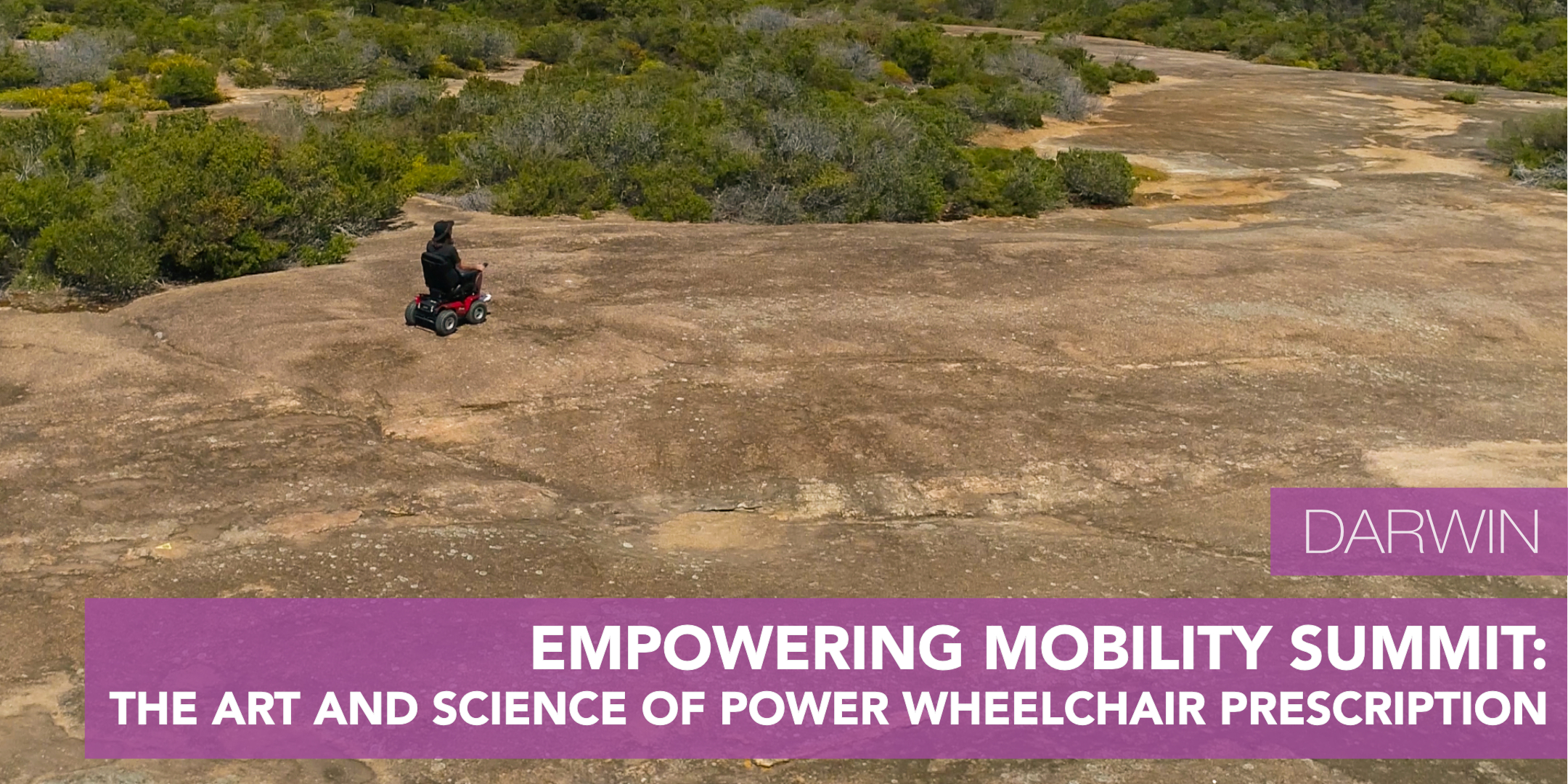
Empower Mobility Summit: A Clinician Education Day
Join us for a full-day powered mobility summit combining practical learning, clinical discussion and hands-on equipment experience.
Across two education streams, explore key considerations in power wheelchair assessment, selection and prescription. Topics will include choosing between power wheelchairs and power assist, alternative drive controls, power seat functions, off-road mobility, and using programming and equipment adjustments to support individual function and mobility.
With live demonstrations, practical insights and opportunities to learn directly from clinical and industry experts, the day will help you build confidence and develop strategies you can apply in your clinical practice.
The workshop will run across two streams, with content tailored to different levels of knowledge and experience. As part of registration, you’ll be asked a few questions about your clinical experience, along with your preferred stream, to help us determine the most suitable stream for you.
When:
Where:
Cost:
Tuesday 20th April 2027
9am – 4.30pm
GTK Darwin, 11/17 Willes Road, Berrimah NT 0828
$75
Stream 1
9am: Welcome
9.15am: Topic to be confirmed
10.30am: Starting the Power Mobility Journey
Kate comes from an occupational therapy background, with two decades of experience in varied settings, specialising in wheelchair seating and positioning. She has followed the evolution of wheelchair seating theory and practice, and enjoys bringing the latest research to therapists practicing in the field.
Kate is also an enthusiastic proponent of posture care over the 24 hour time period, through the lifespan, sharing the appreciation that positioning outside of the wheelchair is just as important as postural alignment in mobility devices.
Kate is passionate about sharing her skills and experiences with therapists, to build their confidence in postural assessment and prescription of wheelchairs and seating. Kate enjoys presenting at larger clinical education events and inservices for therapy groups, as well as supporting therapists with complex postural assessments and equipment prescription.

Prithy Sivaraman has beenworking with children and adults to assess and prescribe seating and wheelchairs since 2007. Starting her Physiotherapy career in Perth, she has worked primarily in community settings and is passionate about maximising independence and access for the client’s she works with. Prithy has experience providing clinical support and advice for therapists prescribing AT both locally and via telehealth. Clinically she has focused on complex seating and alternative access for powered mobility. Now based in Adelaide, Prithy joined the Sunrise Medical clinical team as an Educator in 2020. Her favourite part of the role is developing the assessment skills of therapists in the community and building networks with regional teams to build capacity locally.
12.30pm: Putting the ‘Function’ in Power Seat Functions
Tilly Brook graduated from the University of Adelaide in 2008 with a Bachelor of Health Science followed by a Masters of Occupational Therapy (Hons) in 2010 from the University of Sydney.
Tilly worked within rehabilitation, working primarily with adults with a brain injury until 2015 when she moved to Singapore. In Singapore, she worked with children and adults at the Cerebral Palsy Alliance School (CPAS). In 2017 Tilly’s clinical knowledge continued as she worked with Mobility Solutions in Auckland, New Zealand. On her return to Australia, Tilly assisted in the development of the Clinical Hub Team at Sunrise Medical where her passion and experience for mentoring and educating therapists grew. Tilly Joined Permobil in January 2022 and is driven to grow therapists, enabling them to be the best therapist they can be.

1.45pm: Building from the Base Up: Optimising the Power Wheelchair Selection process
Selecting an appropriate power wheelchair base is an important part of developing a mobility solution that meets an individual’s functional goals, environmental requirements and driving preferences.
We will explore front, mid and rear-wheel drive configurations and dive further into the characteristics impacting manoeuvrability, comfort and drive performance, the role of centre of gravity and suspension in wheelchair stability and the differences between expandable and non-expandable electronics.
The presentation will also examine base adjustability, and the key features therapists should consider when assessing whether a power wheelchair base can be appropriately configured to meet an individual’s current and future needs.
By the end of the presentation, participants will have a practical understanding of the key factors required to match power wheelchair base characteristics to the person, environment and intended use.
Joshua Chiswell is an experienced Occupational Therapist, with a background in complex wheelchair and seating prescription.
He is passionate about helping clinicians build confidence in assistive technology, having seen the powerful impact the right wheelchair and seating solutions can have on people’s lives.
Prior to joining the Quantum team, Josh spent almost a decade working with individuals with diverse and complex needs. He infuses his role as a clinical educator with the practical experience gained from working in inpatient rehabilitation and community settings, as well as collaborating closely with families and multidisciplinary teams.
Josh excels at turning clinical knowledge into real-world solutions that support independence and long-term outcomes.”
3.30pm: Fine-Tuning for Function: Making Adjustments to Powered Wheelchairs
Small adjustments can make a big difference in a powered wheelchair user’s comfort, function, and overall mobility. But knowing when to make those adjustments—and when to call in a technician or Assistive Technology Consultant—is crucial for ensuring safety and optimal performance. This workshop is designed to help therapists build the skills and confidence needed to enhance user independence through fine-tuning powered wheelchair set-up.
You’ll learn to identify when adjustments are safe to perform as a therapist and when more complex changes require specialized expertise. Through hands-on, practical learning, participants will learn which tools to use and gain experience in making common adjustments to wheelchair and seating components to achieve optimal outcomes for participants.
Kate comes from an occupational therapy background, with two decades of experience in varied settings, specialising in wheelchair seating and positioning. She has followed the evolution of wheelchair seating theory and practice, and enjoys bringing the latest research to therapists practicing in the field.
Kate is also an enthusiastic proponent of posture care over the 24 hour time period, through the lifespan, sharing the appreciation that positioning outside of the wheelchair is just as important as postural alignment in mobility devices.
Kate is passionate about sharing her skills and experiences with therapists, to build their confidence in postural assessment and prescription of wheelchairs and seating. Kate enjoys presenting at larger clinical education events and inservices for therapy groups, as well as supporting therapists with complex postural assessments and equipment prescription.
Stream 2
9am: Welcome
9.15am: Topic to be confirmed
We’re working on something exciting, with details of this session to be confirmed closer to the event.
10.30am: Beyond Standard Access: Clinical Consideration for Alternate Drive Controls
Alternative drive controls provide access to powered mobility for individuals who are unable to operate a standard joystick effectively. Successful implementation requires a thorough understanding of the individual’s functional abilities, access requirements and potential to develop safe and effective driving skills.
This presentation will explore the clinical considerations involved in assessing, selecting and implementing alternative drive control solutions. Topics will include assessment and prerequisites for alternate drive control use, the differences between proportional and switch-based inputs, available alternative control options, and strategies for training, skill development and ongoing progression.
By the end of the presentation, participants will have a clearer clinical framework for matching alternative drive control solutions to an individual’s abilities, goals and functional needs, supporting greater independence and participation through powered mobility.
Joshua Chiswell is an experienced Occupational Therapist, with a background in complex wheelchair and seating prescription.
He is passionate about helping clinicians build confidence in assistive technology, having seen the powerful impact the right wheelchair and seating solutions can have on people’s lives.
Prior to joining the Quantum team, Josh spent almost a decade working with individuals with diverse and complex needs. He infuses his role as a clinical educator with the practical experience gained from working in inpatient rehabilitation and community settings, as well as collaborating closely with families and multidisciplinary teams.
Josh excels at turning clinical knowledge into real-world solutions that support independence and long-term outcomes.”
12.30pm: Escaping the Footpath: Unlocking New Horizons (Off-Road Power Mobility)
Prescribing a powerchair often poses many challenges as you consider factors that affect client function and wheelchair performance outside the 4 walls of a clients home. We’ll help you understand the different base types and how they impact on client participation and functional outcomes.
We’ll consider:
- Selecting a suitable base to cover personal and environmental needs
- Funding considerations – what features are necessary rather than desirable

Prithy Sivaraman has beenworking with children and adults to assess and prescribe seating and wheelchairs since 2007. Starting her Physiotherapy career in Perth, she has worked primarily in community settings and is passionate about maximising independence and access for the client’s she works with. Prithy has experience providing clinical support and advice for therapists prescribing AT both locally and via telehealth. Clinically she has focused on complex seating and alternative access for powered mobility. Now based in Adelaide, Prithy joined the Sunrise Medical clinical team as an Educator in 2020. Her favourite part of the role is developing the assessment skills of therapists in the community and building networks with regional teams to build capacity locally.
1.45pm: The Ins and Outs and How to Make a Real Difference to a User’s Function and Mobility through Functional Programming
The programming possibilities of Power Wheelchairs have and continues to evolve – from handheld programmers through to computers, on board programming and now through your phone. The evolution and innovation of technology used in Power Wheelchairs has one focus: to ensure the Power Wheelchair provides the best outcome for the user. As much of this technology is often out of sight, at times it can be out of mind, which can lead to reduced functional outcomes and limit a user’s independence.
In this workshop, you will be provided with the opportunity to get up close and personal with Power Wheelchairs, specifically the programming. We will discuss common (and not so common) difficulties which wheelchair users report when using their Power Wheelchair – and what specific programming changes enable an increase in function and participation. We will provide the links between functional goals and programming outcomes, and how optimal programming can assist users to overcome barriers.
Tilly Brook graduated from the University of Adelaide in 2008 with a Bachelor of Health Science followed by a Masters of Occupational Therapy (Hons) in 2010 from the University of Sydney.
Tilly worked within rehabilitation, working primarily with adults with a brain injury until 2015 when she moved to Singapore. In Singapore, she worked with children and adults at the Cerebral Palsy Alliance School (CPAS). In 2017 Tilly’s clinical knowledge continued as she worked with Mobility Solutions in Auckland, New Zealand. On her return to Australia, Tilly assisted in the development of the Clinical Hub Team at Sunrise Medical where her passion and experience for mentoring and educating therapists grew. Tilly Joined Permobil in January 2022 and is driven to grow therapists, enabling them to be the best therapist they can be.
3.30pm: Fine-Tuning for Function: Making Adjustments to Powered Wheelchairs
Small adjustments can make a big difference in a powered wheelchair user’s comfort, function, and overall mobility. But knowing when to make those adjustments—and when to call in a technician or Assistive Technology Consultant—is crucial for ensuring safety and optimal performance. This workshop is designed to help therapists build the skills and confidence needed to enhance user independence through fine-tuning powered wheelchair set-up.
You’ll learn to identify when adjustments are safe to perform as a therapist and when more complex changes require specialized expertise. Through hands-on, practical learning, participants will learn which tools to use and gain experience in making common adjustments to wheelchair and seating components to achieve optimal outcomes for participants.
Kate comes from an occupational therapy background, with two decades of experience in varied settings, specialising in wheelchair seating and positioning. She has followed the evolution of wheelchair seating theory and practice, and enjoys bringing the latest research to therapists practicing in the field.
Kate is also an enthusiastic proponent of posture care over the 24 hour time period, through the lifespan, sharing the appreciation that positioning outside of the wheelchair is just as important as postural alignment in mobility devices.
Kate is passionate about sharing her skills and experiences with therapists, to build their confidence in postural assessment and prescription of wheelchairs and seating. Kate enjoys presenting at larger clinical education events and inservices for therapy groups, as well as supporting therapists with complex postural assessments and equipment prescription.
We appreciate your interest in our workshop and the desire to get the most out of your experience. However, the workshop has been designed as two distinct learning streams, with each stream offering a carefully structured program covering different content, perspectives and areas of focus.
To provide a cohesive learning experience, attendees will remain within one stream for the duration of the workshop rather than moving between individual sessions.
As part of registration, you’ll be asked a few questions about your clinical experience and areas of practice, as well as your preferred stream. This information will help us determine the stream that best aligns with your current knowledge, experience and learning goals.
If you’re unsure which stream would be the best fit, that’s completely fine. Let us know your preference when registering and we’ll use your responses to help guide stream allocation.